

PATENTS & INTELLECTUAL PROPERTY
Patents & Intellectual Property
Protecting research findings
to advance future care.
To turn research findings into care that reaches patients, publishing papers is only one step. The underlying technologies also need appropriate intellectual property protection.
Biozipcode, Inc. is building an intellectual property portfolio to support therapeutic, diagnostic, and detection applications of its research into abnormal hematopoietic stem cells and bone marrow-derived cells, epigenetic abnormalities, and cell migration. This research examines diabetes and its complications beyond changes in blood glucose alone.
The principal published international applications comprise four PCT patent families concerning therapies targeting abnormal stem cells, stem cell migration, treatment, diagnosis and detection of diabetes and its complications, and HDAC modulation.
PCT international applications and international publications are subject to national-phase procedures; publication itself does not mean that patent rights have been granted in every country. The status of each patent family may differ by country or region, including filing, examination, grant, continuation, division, or abandonment. Records of applicants and right holders may also vary due to transfers of rights from research institutions and national-phase procedures.
This page does not offer a legal opinion on patent validity, scope of protection, ownership, freedom to operate, or any other legal issue. For specific licensing or joint development discussions, we will check current patent records for the relevant countries and patents individually.
INTELLECTUAL PROPERTY STRATEGY
Intellectual property connecting basic research with diagnostics and therapies.
Our intellectual property strategy goes beyond protecting a single treatment.
Starting with disease mechanisms discovered through research, we aim to connect several layers of technology:
DISEASE MECHANISM (understanding the disease process)
Research findings on the role of abnormal hematopoietic stem cells in diabetes and its complications.
THERAPEUTICS (intervening in the disease process)
Therapeutic approaches involving the suppression or migration of abnormal stem cells and intervention in their epigenetic state.
DIAGNOSTICS (measuring the disease process)
Diagnosis, detection, and patient stratification based on the presence, migration, or persistence of abnormal cells.
CELL TARGETING (delivering treatment to the cells that need it)
Combining these approaches with cell-targeting technologies such as Biozipcode™ to integrate diagnostics and therapies in the future.
Together, these layers form the focus of our intellectual property strategy.
ABNORMAL STEM CELL TARGETING
Diabetes Therapy Targeting Abnormal Stem Cells
International Application No.
PCT/JP2020/039044
International Filing Date
October 16, 2020
International Publication No.
WO2021/075535
International Publication Date
April 22, 2021
Inventors
Hideto Kojima / Tomoya Terashima / Miwako Katagi
Title of Invention
Diabetes Therapy Targeting Abnormal Stem Cells
Diabetes Therapy Targeting Abnormal Stem Cells
This invention centers on targeting abnormal hematopoietic stem cells in diabetes and related diseases.
The published application covers not only approaches to suppressing abnormal stem cells but also a diagnostic concept that uses those cells as indicators of diabetes and related diseases. It describes abnormal hematopoietic stem cells with features such as CD106 expression that differ from those of normal cells.
Its concepts relate to the current programs and activities in
- Diabetes Remission Therapy Candidate
- Diabetes Stem Cell Biomarker
- Patient Stratification
This is one of the foundational patent families behind those efforts.
STEM CELL MIGRATION
Therapy for Diabetes Using Stem Cell Migration Agent
International Application No.
PCT/JP2020/039045
International Filing Date
October 16, 2020
International Publication No.
WO2021/075536
International Publication Date
April 22, 2021
Inventors
Hideto Kojima / Tomoya Terashima / Miwako Katagi
Title of Invention
Therapy for Diabetes Using Stem Cell Migration Agent
Therapy for Diabetes Using Stem Cell Migration Agent
Rather than only suppressing stem cells in the bone marrow, this invention concerns a treatment concept that uses stem cell movement and migration to intervene in diabetes.
It relates closely to diabetes stem cell research into where abnormal cells reside in the bone marrow and how they move.
TREATMENT, DIAGNOSIS & DETECTION
Novel Treatment, Diagnosis & Detection of Diabetes and Complications
International Application No.
PCT/JP2022/008036
International Filing Date
February 25, 2022
International Publication No.
WO2022/181797
International Publication Date
September 1, 2022
Inventors
Hideto Kojima / Tomoya Terashima / Miwako Katagi
Title of Invention
Novel Method and Agent for Treating, Diagnosing and Detecting Diabetes and Complications
The invention discloses several ways to use abnormal hematopoietic stem cells:
Suppress them;
mobilize them;
detect their presence;
assess migration from, or persistence in, a particular niche
These approaches are combined for potential treatment and diagnosis of diabetes and related diseases.
Beyond therapeutic approaches, this intellectual property informs several areas of the current diagnostic pipeline:
- Diabetes Stem Cell Biomarker
- Disease Assessment
- Patient Stratification
- Treatment Response Assessment
- Companion Diagnostics
These are among its potential diagnostic applications.
HDAC REGULATION
Treatment of Diabetes and Complications with an HDAC Modulator
International Application No.
PCT/JP2022/040140
International Filing Date
October 27, 2022
International Publication No.
WO2023/074794
International Publication Date
May 4, 2023
Inventors
Hideto Kojima / Miwako Katagi
Title of Invention
Method or Agent with HDAC Regulator, for Treatment of Diabetes and Complications
Method or Agent with HDAC Regulator, for Treatment of Diabetes and Complications
This invention concerns a treatment concept that combines blood glucose control with HDAC modulation to target abnormal stem cells in diabetes and related diseases.
HDAC is involved in epigenetic mechanisms that regulate gene expression and is closely related to the state of abnormal hematopoietic stem cells studied in diabetes models.
This intellectual property supports epigenetic intervention research related to the 2023 Communications Biology report of complete remission in STZ-induced diabetic mice treated with insulin and givinostat.
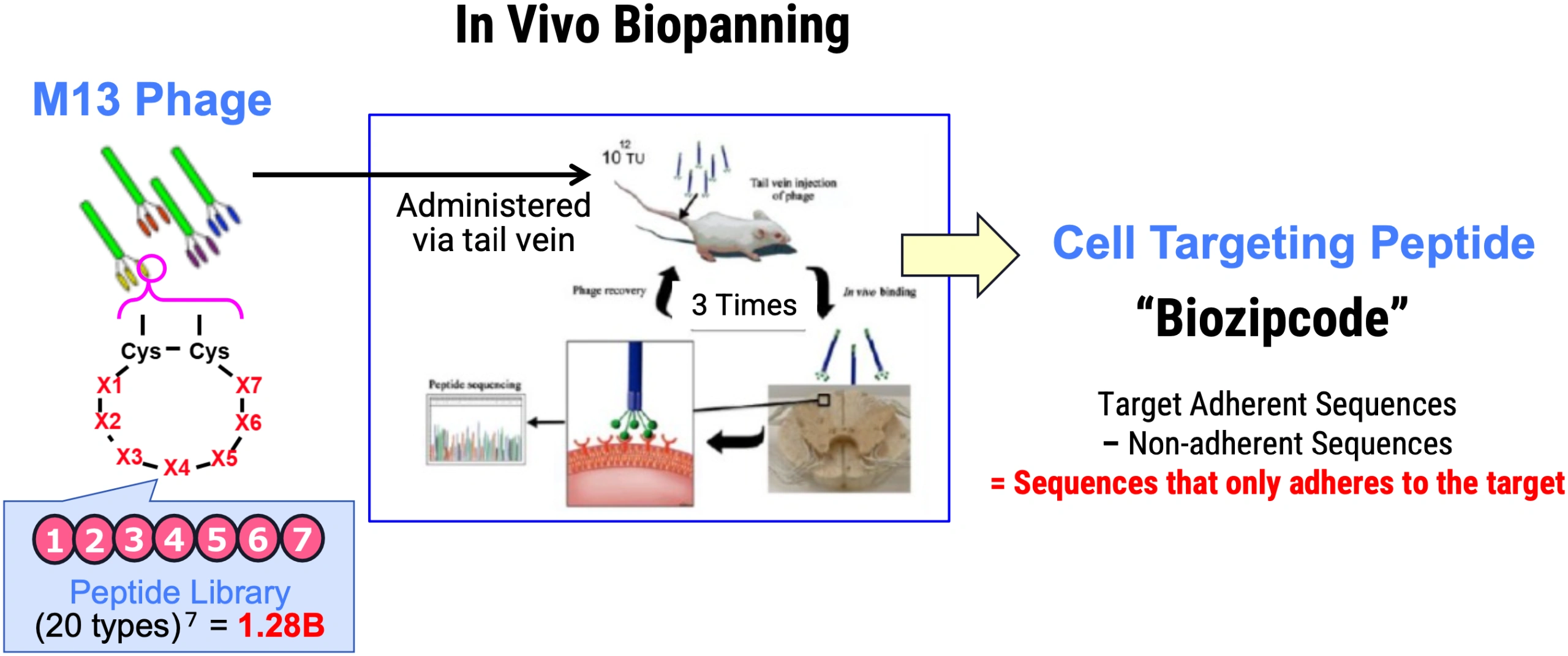
BIOZIPCODE™ INTELLECTUAL PROPERTY
Biozipcode™ Intellectual Property Strategy
Biozipcode™ research identifies short peptides that recognize specific cells and tissues and investigates their applications in diagnostics and drug delivery systems (DDS).
Protecting this technology involves more than one patent. Relevant intellectual property spans:
- Targeting Peptide Sequences
- Methods for Selecting and Analyzing Sequences
- Target Cells
- Diagnostic Uses
- Drug Delivery Uses
- Peptide–Payload Combinations
- DDS & Vectors
- Manufacturing and Evaluation Methods
- Bioinformatics
- Confidential Know-How and Data
Combining these elements is an important part of the strategy.
Research Achievements

Explore publications, patents, and conference presentations from years of research into diabetes, hematopoietic stem cells, cell targeting, and related fields.

Explore key publications on diabetes stem cells, diabetic complications, and complete remission research that underpin our R&D.
Explore our intellectual property work in diabetes treatment, diagnostics, abnormal stem cells, and Biozipcode™ to help bring research findings into practical use.

Explore Biozipcode research and activities through research videos, conference presentations, lectures, and seminars.